
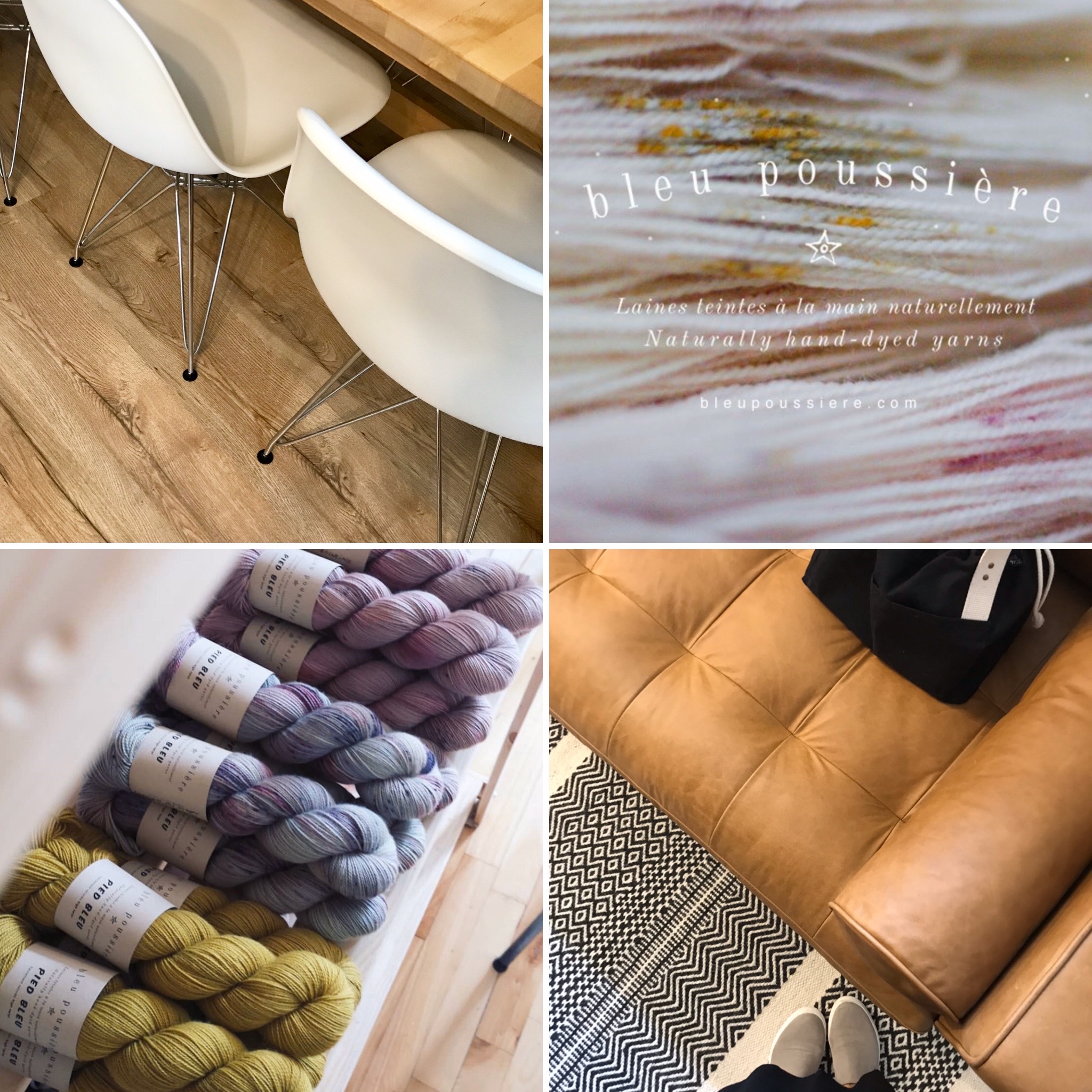
L’équipe d’Espace Tricot est fière d’annoncer l’ouverture officielle de l’Atelier Espace Tricot ! Joignez-vous à nous le samedi 2 novembre entre 13 h et 17 h pour célébrer cette nouvelle aventure! Dans le cadre des festivités, nous sommes ravies d’accueillir Shani Théorêt de Bleu Poussière qui partagera une boutique éphémère avec ses superbes fils teints naturellement. Bien sûr, il y aura aussi des rafraîchissements légers et du vin mousseux, et peut-être quelques prix de présence à gagner!
L’Atelier Espace Tricot est un espace communautaire dédié à l’artisanat et à la créativité, au partage et à l’apprentissage. Nous avons prévu de nombreux événements, allant des cercles de tricot, de crochet et de broderie jusqu’à des ateliers, des soirées cinéma et quiz, des conférences, des activités familiales et plus encore. En ouvrant l’Atelier, notre objectif est de fournir un espace chaleureux et accueillant à notre communauté locale (et aux visiteurs de l’extérieur) pour profiter de la bonne compagnie dans une atmosphère amusante et inspirante.
Nous avons très hâte de partager l’Atelier avec vous tous.
Pour en savoir plus sur Shani, la créatrice de Bleu Poussière, CLIQUEZ ICI !
Chaleureusement,
– Melissa et Lisa
Espace Tricot is proud to announce the official opening of l’Atelier Espace Tricot! Please drop in on Saturday, November 2nd between 1 pm and 5 pm to join us in celebrating this new adventure! As part of the festivities we are delighted to welcome Shani Théorêt of Bleu Poussière who will be sharing her stunning naturally-dyed yarns in a pop-up shop. Of course, there will also be light refreshments and bubbly on hand, and maybe a few door prizes to be won!
L’Atelier Espace Tricot is a community space for crafting and creativity, sharing and learning. We have lots of events planned, from relaxed stitching time, to classes, workshops, movie and quiz nights, a lecture series, family activities, and more. In opening l’Atelier, our goal is to provide a warm and welcoming space for our local community (and out-of-town visitors!) to enjoy good company in a fun and inspiring atmosphere.
We are so excited to share l’Atelier with you.
To find out more about Shani, the creator behind Bleu Poussière, read the short interview below and visit her website HERE.
Warmest regards,
Melissa & Lisa

When did you start Bleu Poussière?
I think many elements contribute to the birth of Bleu Poussière, it was not a linear process from the beginning.
When I was young I was the kid they called « punk » in elementary school. I was the artist of the class, everyone came to me to have their name written in nice lettering and colours. Then, growing up in high school, I dove into the world of street art, in other words, I was a graffiti writer during the most defining period of my life (15 to 21). Colour was and still is my main form of expression – colour was something I defined myself with, long before knitting and dyeing.
After quitting my rebel ways, I realized something was deeply missing. I don’t know how to put this into words but I’ve always been about the realness. The realness of people, the realness of things, the realness of culture. I wasn’t able to create only digital content anymore. I was soul searching. Depression was crawling its way deep inside me and I needed something real to hold onto. That’s when knitting entered my life. Not long afterwards my interest in natural remedies started to grow. At the end of 2016, I was full on into astronomy and theory of light and I’m reading about plants to assist healing and crazy stuff like Kandinsky’s theory of colours and how their frequencies affect us and all that jazz. All I was doing at that time was reading, knitting, and exploring nature. In other words, creating the space needed for something wonderful to emerge.
When I realized I could dye my own yarn with natural colours, I was hooked. So at the end of 2017 I launched my naturally hand-dyed yarns. I sold 13 skeins that opening night, I’ll always remember that, and this was enough for me to believe there was something special with what I was doing. I enrolled in entrepreneurial school that helped me ask myself the right questions about what I was doing. I decided to take a leap of faith and fully take on the role of the artist that I always knew I was and manifest my vision. I kept going and putting myself out there even though I didn’t really know anyone in the knitting community.
People often ask where the name Bleu Poussière (Dusty Blue) comes from. I love to say that it’s essentially my aura colour. It’s a colour that sums up my love of ancient stuff, my love for everything celestial, a colour that evokes calm and yet something a little electric in the air. It’s hard to define but If I could be a colour it would be that colour. It’s also, wonderfully enough, the first colour I hand-dyed naturally with black beans!
Who is involved in Bleu Poussière?
Me (Shani), the founder and jack-of-all-trades. I quickly realized I couldn’t do everything – dyeing, administrating, accounting, marketing, etc. – by myself, and my boyfriend Alex joined in the project. People often ask me if Alex dyes. Yes, he does! He is also a pro at micro speckling and since he joined in the fun, he has helped a lot with developing a broader palette with darker tones. Dyeing natural black remains one of his goals, alongside being the indigo master. He is also my personal chauffeur and career therapist!
What interests you about natural dyeing?
What interests me the most about natural dyeing is the organic way different elements come together to reveal a colour that is alive. Temperature, water pH, time, methods of extraction, etc. It’s like alchemy and I’m the first one to be amazed by every new colour that comes out of the dyepots! I love so many things about natural dyeing because it encompasses so many things that I enjoy and that fascinate me. From chemistry to physics, light to colour, history to practice, natural matters to textile… It is a blessing to have found my dream job.
Describe a day in the life of Bleu Poussière…
For me natural dyeing as a practice is a lifestyle. This means enjoying spending time in nature and observing, reading and researching as well as having the curiosity to try things out and see what happens. Every day is different unless we’re in dyeing mode. Then every day is the same!
We talk and philosophize a lot. We plan dye baths ahead of time because we must transform a natural matter like roots, barks, dried bugs (cochineal) and others prior to obtain a dye bath. This involves specific methods depending on what colour we’re aiming for or material we’re working with. We must also prepare our bare yarns for the dye job which takes a long time (securing all skeins, pre-wetting, sometimes scouring, mordanting, and rinsing). Then we can dye, but that still requires you to be present and check in on your dye bath and yarn. When dyeing is complete and everything has cooled down to room temperature we let the yarn dry cure then wash. That’s without taking into account multiple rinsing steps, the final drying stage, and twisting and labelling the skeins. It’s a long process but the satisfaction outweighs the time.
What exciting plans do you have for the future?
In the near future you can catch our upcoming events on our website (bleupoussiere.com). My vision for the long term though, would be to own a land where we’ll grow most of our natural dyestuffs and run a full-size dye house that is welcoming to all.



























 Espace Tricot Blog